Common Islamic Phrases and When to Use Them
What everyday phrases like alhamdulillah, inshallah, and mashallah mean, and the moments people commonly use them in.
A handful of Arabic phrases turn up constantly in Muslim conversation — in messages, in greetings, in the middle of otherwise-English sentences. If you’ve heard them and weren’t sure what they mean or when they fit, this guide walks through the most common ones: what each says, and the moments people usually say it in.
This is a language guide, not religious instruction. It describes how phrases are commonly used, not what anyone is required to say.
Phrases you’ll hear every day
| Phrase | Arabic | Meaning | Commonly said when |
|---|---|---|---|
| alhamdulillah | الحمد لله | Praise be to God | Expressing gratitude or contentment — often the answer to “how are you?“ |
| inshallah | إن شاء الله | God willing | Talking about the future, plans, or hopes |
| mashallah | ما شاء الله | What God has willed | Admiring something good — a child, a home, an achievement |
| subhanallah | سبحان الله | Glory be to God | In awe or wonder at something beautiful or striking |
| bismillah | بسم الله | In the name of God | Before starting something — a meal, work, a journey |
alhamdulillah is the one you’ll hear most. It covers a wide emotional range: genuine gratitude for good news, quiet contentment, and also acceptance when the news is hard.
inshallah attaches to statements about the future — “see you tomorrow, inshallah.” It acknowledges that plans depend on more than the planner. Worth knowing: because it’s so common, it’s occasionally used as a soft way of avoiding a firm commitment, and that’s usually clear from tone and context rather than the words.
mashallah is said when praising something. Crediting a blessing to God is also why it’s felt to guard against the evil eye, which is why people often add it to a compliment about someone’s child or new home.
Thanking someone
jazak Allah khayran (جزاك الله خيرا) means “may God reward you with good.” It’s a warmer, more complete thank-you than a plain شكرا (shukran), and it’s very common between friends and family.
The usual reply is wa iyyak (وإياك) — “and you too.” If you’re replying to more than one person, that becomes wa iyyakum (وإياكم).
Greetings and their replies
Most Arabic greetings come in pairs, and knowing the reply matters more than knowing the greeting. The core one is as-salamu alaykum (السلام عليكم), “peace be upon you,” answered with wa alaykum as-salam (وعليكم السلام), “and upon you, peace.”
Both can be extended — السلام عليكم ورحمة الله وبركاته adds “and God’s mercy and blessings” — and the reply is usually extended to match. Matching the length of the greeting you received is a small courtesy that reads as warm.
Phrases tied to an occasion
Some phrases only appear at particular moments:
- رمضان مبارك (ramadan mubarak) — a blessed Ramadan.
- عيد مبارك (eid mubarak) — for both Eids.
- كل عام وأنتم بخير (kullu aam wa antum bi-khayr) — “may you be well every year,” used for Eid and other recurring occasions.
- جمعة مباركة (jumu’ah mubarakah) — a blessed Friday.
- تقبل الله منا ومنكم (taqabbal Allah minna wa minkum) — “may God accept from us and from you,” said around Ramadan and Eid.
Phrasing varies, and that’s normal
Spelling in Latin letters is not standardized — inshallah, in sha Allah, and insha’Allah are the same phrase written differently, and none is the “correct” one. Usage varies too: some phrases are everywhere in one country and rare in another, and families have their own habits.
Phrases and customs vary by region and community, so choose wording that feels right for your context. If you’re writing to someone specific, the safest guide is what they say to you.
Writing these phrases yourself
If you want to type these rather than copy them, you can write Arabic with the Latin letters you
already have — slam produces سلام, and rmDan produces رمضان. The
guide to typing Arabic online
covers the typing styles in more detail.
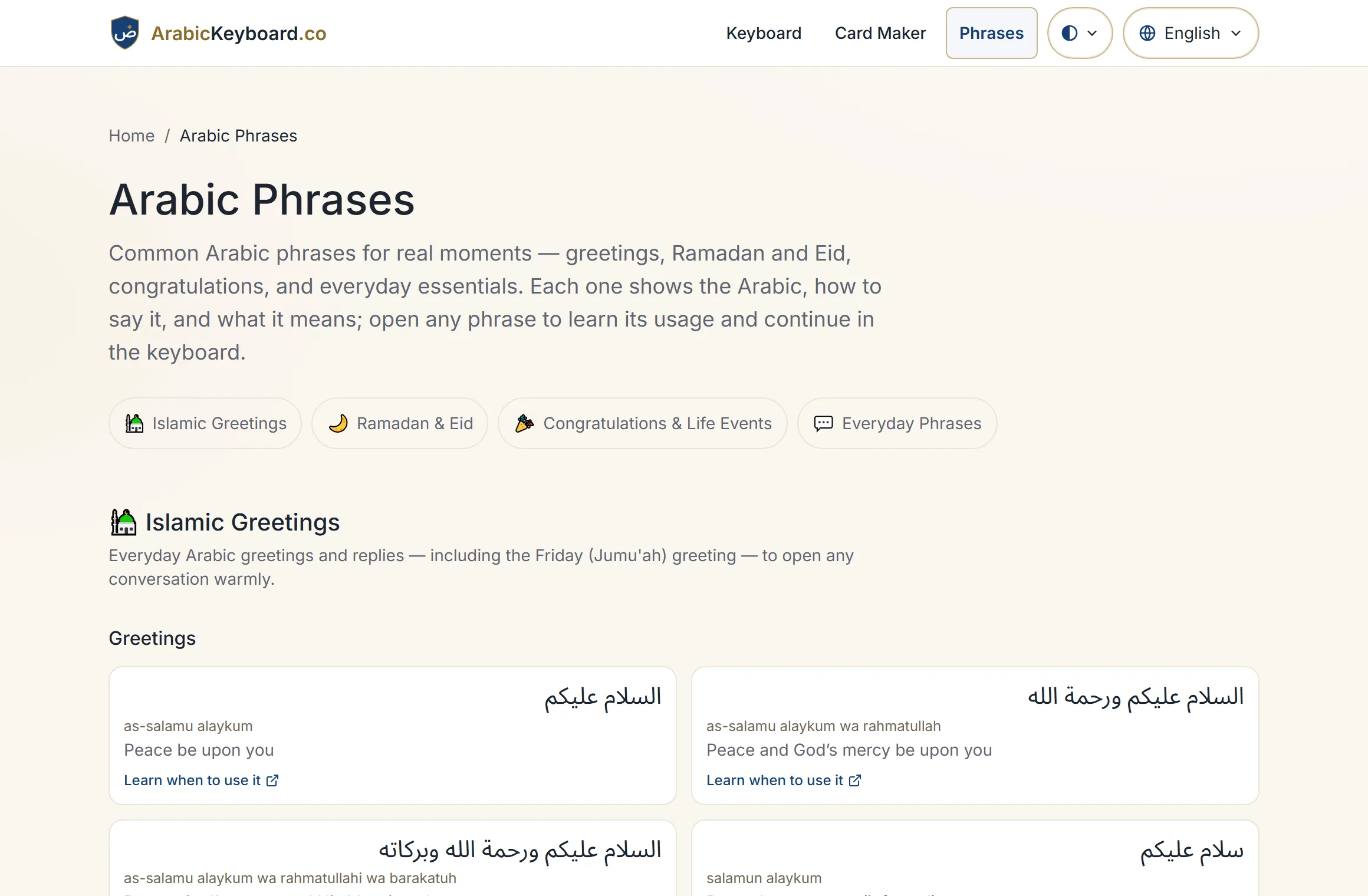
For phrases you’d rather not type from memory, the Arabic phrases library groups them by occasion, with the Arabic, how to say it, and what it means on every card:
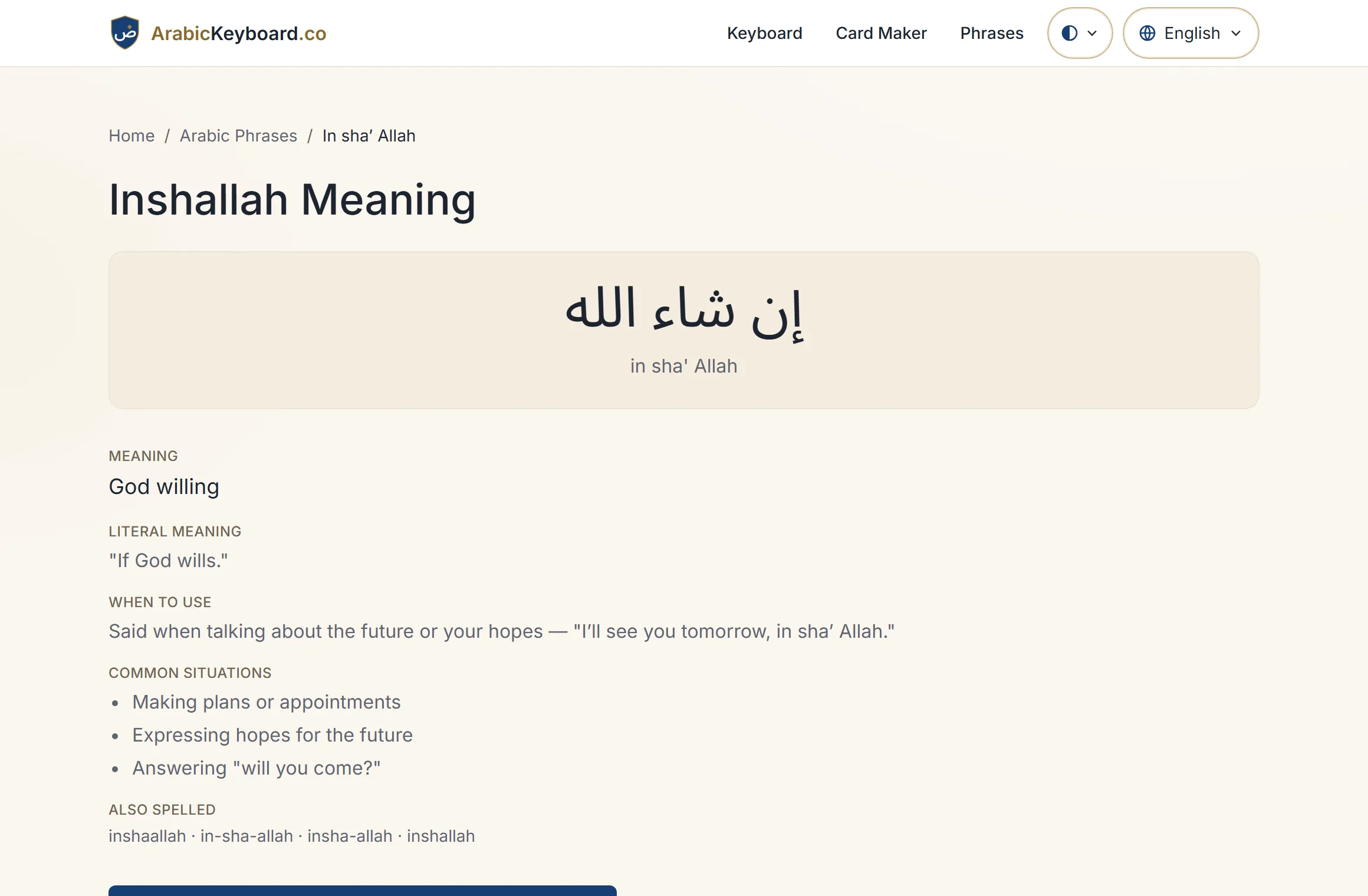
Opening a phrase gives you the fuller picture — its meaning, its literal sense, when it is commonly said, and the situations it fits — for inshallah, mashallah, alhamdulillah, and the rest:
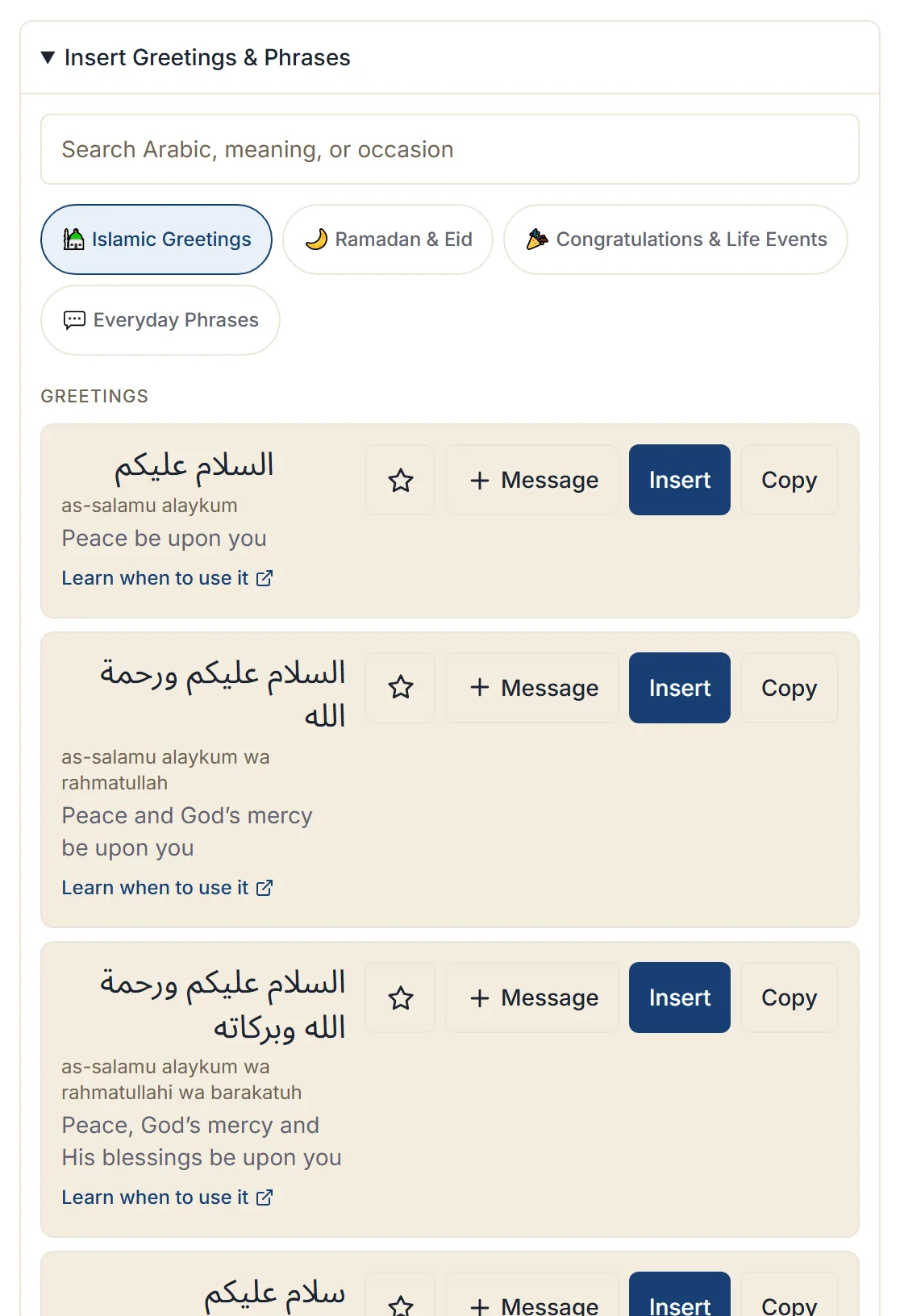
The same phrases sit inside the keyboard itself, so you can search them, insert one into your message, and edit it from there:
Next step
Browse the Arabic phrases library by occasion, or open the Arabic keyboard and write your message.