Write Arabic With Latin Letters
How to spell Arabic words using the Latin keys you already have — which letters to leave out, what the capitals do, and the spellings that catch people out.
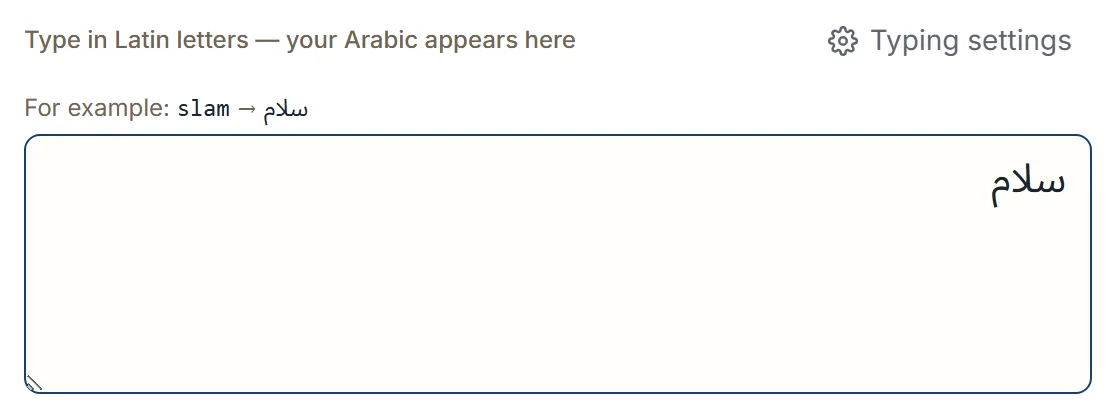
You can write Arabic with the Latin letters already printed on your keyboard. Type slam and سلام
appears; type ktab and you get كتاب. There is no Arabic layout to learn and nothing to install —
but there is a spelling logic to it, and the few minutes it takes to learn are what separate
“this works” from “why did it write that?”
Spell the consonants, not the sounds
The single most useful habit: type the letters an Arabic writer would actually write, not the letters you hear.
Arabic is normally written without its short vowels. Those little marks above and below the letters are optional, and everyday writing leaves them out. So the word you are aiming for has fewer letters than the English spelling suggests:
| You want | Type | Not |
|---|---|---|
| كتاب (book) | ktab | kitab, which gives كيتاب |
| سلام (peace) | slam | salam, which gives سالام |
| بيت (house) | byt | |
| قلم (pen) | qlm |
Every a, i, u, o and e you type is a real character request. a asks for ا, and i
asks for ي. Type kitab and you get exactly what you asked for — ك ي ت ا ب — which is كيتاب, not
كتاب. Leave the short vowels out and the word comes out right.
Capital letters reach the second letter of a pair
Arabic has several pairs of letters that English collapses into one. The keyboard uses capitalisation to tell them apart, so a shifted key is a different letter, not a louder one:
| Type | Get | Type | Get |
|---|---|---|---|
h | ه | H | ح |
s | س | S | ص |
t | ت | T | ط |
d | د | D | ض |
z | ز | Z | ظ |
This matters more than it looks. mrHba gives مرحبا, the ordinary word for hello. Type the same
thing with a small h — mrhba — and you get مرهبا, which is not a word. Nothing warns you; the
letters simply come out different, so it is worth checking the capitals when a word looks off.
The apostrophe adds the dots
The other trick is the apostrophe. Several Arabic letters are the same shape with different dots,
and typing ' after a letter moves you to the dotted one:
| Type | Get | Type | Get |
|---|---|---|---|
t' | ث | d' | ذ |
s' | ش | g' | غ |
H' | خ | h' | ة |
So شكرا — thank you — is s'kra. This catches out almost everyone the first time, because the
instinct is to type shkra the way it is usually written in Latin letters. In this typing style
that reads as two separate letters, s and h, and produces سهكرا. If you would rather type
shkra and have it work, that is exactly what the English typing style is for — you can
switch in Typing settings, and the typing style guide
covers what each one changes.
The last one in that table is worth singling out. h' gives ة, the ta marbuta that ends a great
many words: mdinh' gives مدينة, and mdrsh' gives مدرسة.
Watch out for la
One combination behaves differently from everything else. la is not l followed by a — it is
the single ligature لا, which is how Arabic writes those two letters together.
That is why salam gives سالام rather than سلام: the keyboard reads s, then a, then la, then
m. It is doing exactly what you asked; you just asked for something else. Drop the first vowel,
type slam, and you get سلام.
Letters the keyboard leaves alone
If you type a key that has no Arabic meaning in this style, it stays as it is rather than
guessing. e, o, u and x all pass straight through, which is why nor comes out as نoر
with a Latin o sitting in the middle. The fix is noor, since oo is the pair that gives و.
Seeing a stray Latin letter in your Arabic is almost always this: a vowel that has no home in the current typing style.
Next step
Open the Arabic keyboard and type slam, then mrHba, then s'kra. Three
words is enough to feel the pattern — consonants first, capitals for the heavy letters, apostrophe
for the dotted ones. When you hit a letter you cannot work out, the
tricky letters guide has the awkward ones in one place.
And if you would rather read the Arabic you are producing than keep transliterating it, the Arabic reading course starts from the very first letter.