Search Arabic Phrases by Occasion or Meaning
Find the right Arabic phrase by typing what you mean, the occasion, or a half-remembered spelling — and what the search is and is not forgiving about.
You usually know what you want to say before you know how to spell it. “Something for Eid.” “The reply to a greeting.” “That phrase for congratulating someone.”
The phrase search is built for exactly that, so you can type the meaning or the occasion rather than the Arabic.
Two ways in
From the keyboard. Expand Insert Greetings & Phrases below the typing box and use the search field. Results appear as you type, and each one can be inserted into your text in a click.
From the phrase library. The phrase library is a browsable index — greetings, Ramadan and Eid, congratulations and life events, and everyday phrases — where each phrase has its own page explaining what it means and when it is used.
Use the first when you are mid-message, and the second when you want to understand a phrase before using it.
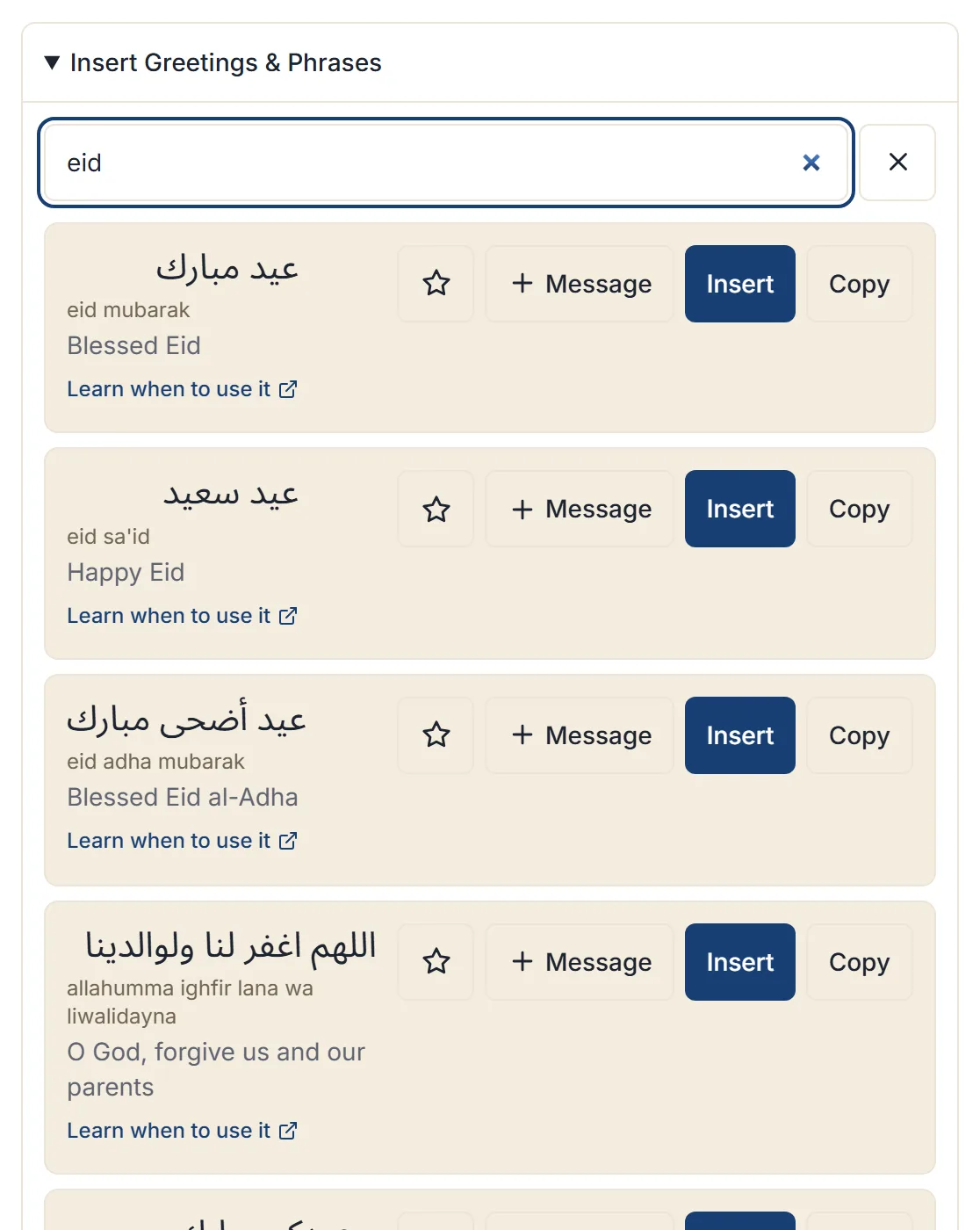
What you can search by
The field accepts three quite different kinds of query, and you do not have to say which:
- The meaning in English — thank you, congratulations, good morning.
- The occasion — Eid, Ramadan, wedding, Friday.
- The Arabic or its transliteration — either script, however you happen to spell it.
It is forgiving about spelling
This is the part worth knowing, because it means a rough guess usually works.
The search folds away the differences that trip people up:
- Harakat are ignored. A phrase spelled with diacritics is found by a query without them.
- Hamza forms fold together. أ, إ and آ all match a plain ا, so you do not have to get the hamza right.
- The ta marbuta and alif maqsura fold to ه and ي, which are the letters people commonly type instead.
- Doubled letters collapse, so salaam finds the same phrase as salam.
- Vowel spellings fold together, so alaykum, aleikum and alikum all land in the same place — and eid and id are treated as the same word.
- Apostrophes and hyphens are dropped, so as-salamu and assalamu behave identically.
In practice: type it the way it sounds to you, in either script, and it will very likely be found.
What it does not do
Being clear about the limits saves you guessing why something failed:
- Chat-number spelling is not converted. Searching 3id will not find عيد — the search does not read digits as letters, even though the keyboard does. Type eid.
- It does not translate sentences. It matches phrases in the library; it is not a way to look up arbitrary Arabic.
khandshare not folded to other spellings. Sound-alike substitutions across different letters are not treated as equivalent.
If a search comes back empty, the panel says so rather than showing something approximate. Widen the query — one word usually beats three.
Browsing when you do not have a word for it
Sometimes you cannot name what you want. The library is grouped by occasion for exactly that case:
| Category | For |
|---|---|
| Islamic Greetings | Everyday greetings and their replies, including the Friday greeting |
| Ramadan & Eid | Blessings and congratulations for Ramadan, Eid al-Fitr, and Eid al-Adha |
| Congratulations & Life Events | Weddings, new babies, graduations, and other happy occasions |
| Everyday Phrases | Thanks, please, yes, no, and the expressions used most |
Open a category and read down it. Each phrase shows the Arabic, how to say it, and what it means, and its own page covers when it is used and what people usually reply.
Phrases and customs vary by region and community, so choose wording that feels right for your context.
Once you have found it
Insert it into the editor and keep writing around it, copy it on its own, or star it so it is one click away next time. The inserted Arabic is the reviewed spelling from the library, which is a good reason to insert a phrase rather than retype it.
Next step
Open the phrase library and search for the occasion you are writing for. If you need several phrases in one message, building a message from ready phrases puts them together for you.